Aquarium, habitat or exhibit
Large land animals live in Habitats, small ones in Exhibits, and fully aquatic species in Aquariums. This is new: the first Planet Zoo had neither aquariums nor fully aquatic animals. The Steam store page talks about "fully aquatic and flying species for the first time". Any "aquarium" guide from before 2026 is about a different game.
Semi-aquatic animals, such as the Eurasian Beaver or the African Penguin, still live in a regular habitat with water. Only fully aquatic species need an aquarium. There are 37 of them: 21 live only in aquariums, and 16 small fish can be kept in an aquarium or an exhibit. The Moon Jelly lives only in an exhibit.
How to build an aquarium step by step
- Open the Habitat Barrier tool and choose Aquarium. Aquarium barriers have their own section in the barrier menu.
- Draw the walls with the Line or Curve tool. Size it to the minimum Deep water area in the table below, with room to spare for a guest tunnel.
- Place an Aquarium Staff Gate on the barrier and connect it to your staff paths. The space fills with water automatically, Freshwater by default. You can raise the gate above the ground.
- Bring power to the gate. Without power you can't set the temperature, and the filters need power too. Green energy has a longer range and no running costs, but costs more to buy.
- Build a Filtration Network with Water Filters and connect it to the node on the Aquarium Staff Gate.
- In Edit Filtration Network, set the Salinity your species need.
- In the aquarium panel's Environment tab, set a temperature within the species' range.
- From the Aquarium tab in the Browser, add feeders, nests and enrichment. Aquatic plants, scenery and terrain tools help meet each species' environment needs.
- Release the animals, send a Keeper to the aquarium and add it to your staff's Work Zone.
Want to rebuild it later? First move the animals into crates, then use the Drain Water button under the info panel. Only with no water and no animals can you use the Barrier Tool to change the wall height or lower the terrain.
Water: salinity, temperature and filtration
Salinity
There are three levels: Freshwater, Brackish and Saltwater. You set salinity for the whole filtration network, not for one tank: "Changing the Salinity Level of a Filtration Network affects the Salinity of all connected Water Bodies" (Frontier's guide). So keep freshwater and saltwater on separate networks. Water Pumps from habitats connected to the same filter will change salinity too, and swimming and wading land animals only drink freshwater.
An animal in the wrong salinity can die from Osmotic Stress. Most marine species need Saltwater, while the West Indian Manatee accepts Any Salinity.
Temperature
You can set the temperature in the Environment tab only when the staff gate has power. The further the set temperature is from the weather, the more the aquarium costs to run. The coldest water suits the Ocean Sunfish (from 10°C) and the Brown Trout (12–19°C), the warmest the Blue and Gold Fusilier (up to 31°C). Many reef fish share a 24–28°C range, which makes them easy to combine.
Filtration and cleanliness
An aquarium must stay connected to filters at all times. The game tracks two values:
| Value | What lowers it | What restores it |
|---|---|---|
| Water Cleanliness | time, a large aquarium, many animals | a Filtration Rate higher than the demand |
| Tank Cleanliness | time, and "significantly more quickly" with dirty water | Keepers cleaning inside the aquarium |
Both values too low mean disease risk. A sick animal then goes to quarantine and to the Vet.
How much water does one filter clean? Sources differ. The English version of Frontier's guide says "up to 500m2 of water", while the German, Italian, Spanish, French and Brazilian versions of the same guide say 500 m³ (German guide). The English unit is probably a mistake. In practice, check the filtration network panel: the rate must be higher than the demand.
Tunnels, glass and multi-level aquariums
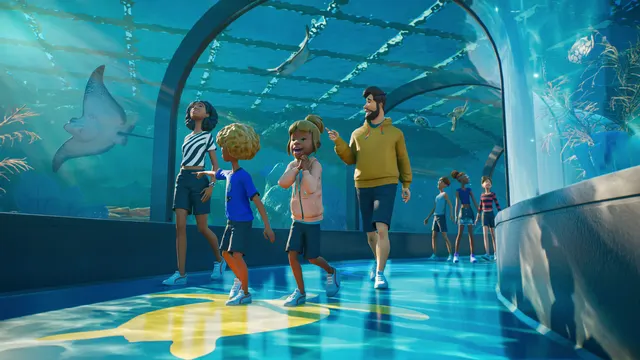
Height matters in aquariums: you can build multi-storey and underground tanks, tunnels at different heights and invisible habitat barriers. There is also one-way glass, plus concave and convex sections.
A guest tunnel first needs an Aquarium Guest Gate on the aquarium barrier. You can place several guest gates. The tunnel cuts into the aquarium's space, so the tank must be large enough beforehand to avoid hurting Animal Space Welfare.
Shape matters too. Sharks swim along the walls, and Frontier suggests a "dumbbell" shaped tank. Species also prefer different water layers: the Blacktip Reef Shark swims closer to the surface than the Great Hammerhead.
Shoals: how they work
The game manages many fish as shoals rather than individuals. A shoal has shared welfare, no genetics, and doesn't breed or die like a single animal. With good welfare it grows to a maximum, and the extra fish split off into a new shoal (contraception prevents this). With poor welfare it shrinks until it dies out. Koi have colour morphs.
How many fish are in a shoal? Sources differ. The Zoopedia lists a preferred group of 1–5 for shoals (1–3 for the Pacific Sardine, 1–4 for several species). It's unclear whether that means fish or shoals. A PawsBuild video recorded before launch showed a Schooling Bannerfish shoal with a range of 40–60 fish. Until this is confirmed in the current version, go by the Zoopedia and the shoal panel in the game.
You can release surplus freshwater fish into the lakes of Wildlife Reserves. In the Awesome Aquatics video, Frontier released African Tigerfish this way. More in our Wildlife Reserves guide.
Staff in aquariums
There is no separate diver or aquarist role. Regular staff enter the water in a diving suit (Frontier: "Staff enter Aquariums directly into the water in a diving suit"):
| Staff | What they do at the aquarium |
|---|---|
| Keeper | cleans the tank, restocks food; needs a nearby Keeper Hut |
| Mechanic | repairs aquarium barriers, power and water filters |
| Caretaker | moves animals into and out of the aquarium |
| Vet | treats sick animals and removes dead ones |
Keep an eye on your Mechanics. Aquarium barriers wear down and crack over time, and leaks appear when their condition gets too low. Guests then run away, and an inspector ends the inspection and issues a Fine.
Shared aquariums and enrichment
Frontier warns: "not all of our aquatic animals can be mixed". Based on the Zoopedia compatibility lists (after the changes in update 1.0.4), the groups look like this:
| Group | Species |
|---|---|
| Reef shoals (Saltwater) | Pacific Bluefin Tuna, Clown Anemonefish, Schooling Bannerfish, Longfin Batfish, Threespot Damselfish, Blue and Gold Fusilier, Bluespine Unicornfish, Golden Trevally, Indian Ocean Oriental Sweetlips, Indo-Pacific Sergeant, Pacific Sardine, Palette Surgeonfish, Yellow Tang |
| Large reef animals | Blacktip Reef Shark, Sand Tiger Shark, Indo-Pacific Leopard Shark, Javanese Cownose Ray, Ocellated Eagle Ray, Hawksbill Turtle, Humphead Wrasse, Giant Grouper, Dolphinfish, Sailfin Snapper, Blackspotted Puffer, Clown Triggerfish, Red Lionfish, Ocean Sunfish |
| Tropical freshwater | Blunthead Cichlid, Giant Gourami, Clown Loach, Boeseman's Rainbowfish |
| Pond | Koi, Common Rudd |
| No tank mates | West Indian Manatee, Great Hammerhead, African Tigerfish, Brown Trout |
Reef shoals and large reef animals are not on each other's lists, so don't mix them without checking the Zoopedia. The Ocean Sunfish has only 7 neutral partners. The Indo-Pacific Leopard Shark, Javanese Cownose Ray, Ocellated Eagle Ray and Humphead Wrasse get along best: they have "Thriving" relationships.
The most common feeders are the Aquatic Feeder - Flakes (18 species) and Suspended Bait (11 predators). Popular enrichment includes the Bubble Blower - Airstone (16 species) and the Submarine Buoy (15). If you forget a feeder, staff will leave a free-floating feeder in the water, and the animals can also graze on aquatic plants.
Aquatic species: Zoopedia requirements
Deep water is the minimum "Deep water area". Barrier height is 1 m for every species. Type: "single" means animals managed individually, "shoal" lives only in aquariums, and "shoal, also exhibit" means small fish that can live in an Exhibit as well.
| Species (in-game name) | Type | Deep water, min. | Salinity | Temperature | Barrier |
|---|---|---|---|---|---|
| Great Hammerhead (Deluxe) | single | 960 m² | Saltwater | 20–28°C | Grade 3 |
| Sand Tiger Shark | single | 420 m² | Saltwater | 16–28°C | Grade 3 |
| Dolphinfish | single | 400 m² | Saltwater | 24–28°C | Grade 2 |
| Ocean Sunfish | single | 300 m² | Saltwater | 10–25°C | Grade 2 |
| Blacktip Reef Shark | single | 210 m² | Saltwater | 22–28°C | Grade 2 |
| Ocellated Eagle Ray | single | 180 m² | Saltwater | 24–27°C | Grade 2 |
| Giant Grouper | single | 150 m² | Brackish, Saltwater | 24–29°C | Grade 2 |
| Hawksbill Turtle | single | 100 m² | Brackish, Saltwater | 22–30°C | Grade 2 |
| Javanese Cownose Ray | single | 80 m² | Brackish, Saltwater | 24–30°C | Grade 2 |
| Humphead Wrasse | single | 60 m² | Saltwater | 22–30°C | Grade 2 |
| Sailfin Snapper | single | 40 m² | Saltwater | 22–29°C | Grade 1 |
| Indo-Pacific Leopard Shark | single | 36 m² | Saltwater | 24–29°C | Grade 2 |
| West Indian Manatee | single | 20 m² (+150 m² Aquatic) | Any Salinity | 23–30°C | Grade 2 |
| Blackspotted Puffer | single | 16 m² | Saltwater | 23–27°C | Grade 1 |
| Clown Triggerfish | single | 16 m² | Saltwater | 23–30°C | Grade 1 |
| Red Lionfish | single | 16 m² | Saltwater | 22–28°C | Grade 2 |
| Pacific Bluefin Tuna | shoal | 200 m² | Saltwater | 17–26°C | – |
| Golden Trevally | shoal | 100 m² | Saltwater | 24–30°C | – |
| Indian Ocean Oriental Sweetlips | shoal | 100 m² | Saltwater | 24–28°C | – |
| Longfin Batfish (Deluxe) | shoal | 100 m² | Saltwater | 22–28°C | – |
| Pacific Sardine | shoal | 50 m² | Brackish, Saltwater | 15–26°C | – |
| African Tigerfish | shoal, also exhibit | 100 m² | Freshwater | 22–30°C | – |
| Clown Loach | shoal, also exhibit | 100 m² | Freshwater | 25–30°C | – |
| Giant Gourami | shoal, also exhibit | 100 m² | Freshwater, Brackish | 24–28°C | – |
| Blunthead Cichlid | shoal, also exhibit | 50 m² | Freshwater | 24–27°C | – |
| Boeseman's Rainbowfish | shoal, also exhibit | 50 m² | Freshwater | 25–28°C | – |
| Brown Trout | shoal, also exhibit | 50 m² | Freshwater | 12–19°C | – |
| Common Rudd | shoal, also exhibit | 50 m² | Freshwater | 18–24°C | – |
| Koi | shoal, also exhibit | 50 m² | Freshwater | 18–25°C | – |
| Blue and Gold Fusilier (Deluxe) | shoal, also exhibit | 50 m² | Saltwater | 21–31°C | – |
| Bluespine Unicornfish | shoal, also exhibit | 50 m² | Saltwater | 24–29°C | – |
| Clown Anemonefish | shoal, also exhibit | 50 m² | Saltwater | 24–28°C | – |
| Indo-Pacific Sergeant | shoal, also exhibit | 50 m² | Saltwater | 24–28°C | – |
| Palette Surgeonfish | shoal, also exhibit | 50 m² | Saltwater | 23–28°C | – |
| Schooling Bannerfish | shoal, also exhibit | 50 m² | Saltwater | 24–28°C | – |
| Threespot Damselfish | shoal, also exhibit | 50 m² | Saltwater | 24–28°C | – |
| Yellow Tang | shoal, also exhibit | 50 m² | Saltwater | 24–28°C | – |
"–": the Zoopedia lists no barrier for shoals. For all 136 animals, see our full animal list.
Known aquarium issues (as of update 1.0.5)
- Deformed fish. In the Reddit thread "My fish are broken" (about 1,545 points), a player showed fish with twisted models. When clicked, the game showed a sardine shoal ("They think they're sardines…", the author writes). The author fixed it by boxing the fish and unboxing them again (box and unbox). This is one player's workaround: Frontier hasn't confirmed it, and the 1.0.4 and 1.0.5 patch notes have no entry for this bug.
- Animals boxed too often. Players report animals being boxed over and over at the staff gate. In both updates Frontier lists "Animals are being boxed more frequently than usual" as an ongoing issue.
- Shoal health at 0% in Franchise mode. Players on Steam report shoals with zero stats. Update 1.0.4 improved shoal welfare requirements, but Frontier hasn't confirmed a fix for this bug.
- Fixed in 1.0.4 (October 14, 2026): shoals teleporting after they die, shoal welfare requirements, animal temperature calculations; the shoal panel now shows social group welfare information.
- Fixed in 1.0.5 (October 16, 2026): fish getting stuck outside an aquarium when moving the habitat, shoals not using new space when an aquarium is expanded, vets getting stuck removing dead animals.
Other bugs and workarounds are in our bugs and known issues guide.
Frequently asked questions
How do I fill an aquarium with water?
Place an Aquarium Staff Gate on the aquarium barrier. The space fills with water automatically, Freshwater by default. You can switch to Saltwater or Brackish in Edit Filtration Network once the filters are connected.
Are there dolphins or seals in Planet Zoo 2?
No. The Zoopedia has no cetaceans or seals. The Dolphinfish is a fish (mahi-mahi), not a dolphin. The only mammal in an aquarium is the West Indian Manatee.
Should I keep small fish in an aquarium or an exhibit?
16 small fish species can live in either. An exhibit is simpler: it needs no staff gate and, once powered, keeps its own temperature and salinity. An aquarium needs a staff gate and filtration, and Frontier's guide describes guest tunnels (through an Aquarium Guest Gate) only for aquariums.