What are wildlife reserves in Planet Zoo 2
A reserve is a separate, large map in the wild where you move animals bred in your zoo.
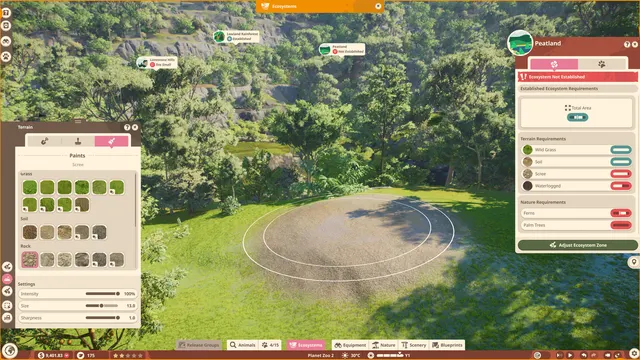
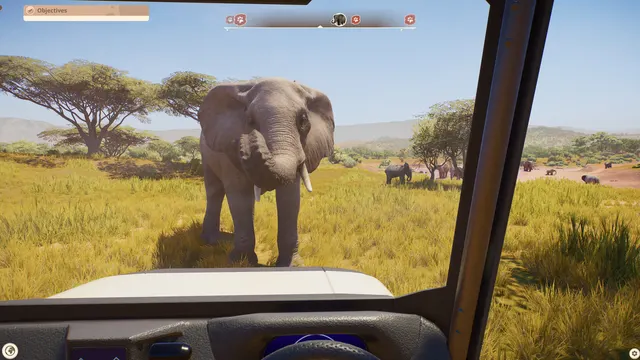
In the first game, releasing an animal was a single button: the animal disappeared and you got CC. In Planet Zoo 2 you design the terrain yourself, paint ecosystems and then watch the released animals from a research vehicle.
Animals in a reserve live until they die naturally, breed and migrate. They need less care than in a zoo, but you have less control over them. Predators really hunt: in a popular Reddit thread players describe lions killing elephants.
Reserves work in every mode: Career, Franchise and Sandbox.
All reserves at launch
There are 6 reserves at launch. That is what Destructoid, games.gg, the Career scenario list and players report. Prima Games writes about "five Wildlife Reserves", but we go with 6, because the other sources list all six by name.
| Reserve | Continent | Terrain (what is known) | Releasable species | Examples |
|---|---|---|---|---|
| Great Rift Valley | Africa | grasslands, 6 ecosystems | 27 | Lion, Plains Zebra, Meerkat, Shoebill |
| Tanzania | Africa | grasslands | 28 | same as Great Rift Valley, minus Meerkat, plus Common Ostrich and Thomson's Gazelle |
| Sumatra | Asia | rainforest, Forest Swamp ecosystem | 15 | Sumatran Tiger, Sumatran Orangutan, Asian Elephant |
| Sweden | Europe | 6 ecosystems, including Moorland | 12 | Eurasian Brown Bear, Eurasian Lynx, Grey Wolf |
| Scottish Highlands | Europe | 5 ecosystems | 11 | same as Sweden, minus Eurasian Brown Bear |
| Poland | Europe | no data | 11 | European Bison, Eurasian Bittern, Grey Wolf |
Species counts come from Destructoid, ecosystem counts from player reports. Some species are locked behind accreditation tiers. There are no reserves in the Americas or Australia yet.
Players recommend starting in Europe: "stay away from the African reserves… too many different species". The three European reserves have few species and almost the same set, so the same animals work in several places.
The Poland reserve
The Poland reserve appears in Chapter 4 of Career, together with Tanzania. You can release 11 species there:
| Species | In-game name |
|---|---|
| European bison | European Bison |
| Eurasian bittern | Eurasian Bittern |
| Grey wolf | Grey Wolf |
| Red deer | Red Deer |
| Wild boar | Wild Boar |
| Eurasian beaver | Eurasian Beaver |
| White-tailed eagle | White-Tailed Sea Eagle |
| Golden eagle | Golden Eagle |
| Long-eared owl | Long-Eared Owl |
| Brown trout | Brown Trout |
| Common rudd | Common Rudd |
According to the Destructoid list, the European Bison and Eurasian Bittern are only found here, no other reserve has them. On the other hand, Poland has no brown bear, lynx or mountain hare, which you get in Sweden. Watch out with the bittern: players say it needs a Flourishing ecosystem, so you release it after other species.
How to unlock a reserve
Career. You start in the Great Rift Valley as a member of the FEN organisation. Further reserves open by chapter: Scottish Highlands in Chapter 2, Sumatra and Sweden in Chapter 3, Poland and Tanzania in Chapter 4. According to the wiki, Sumatra needs 7 Bronze medals and Accreditation Tier 3. More in our Career mode guide.
Franchise. You create a new reserve in the Planet Hub: pick it from the list, name it, adjust the settings and click Create Wildlife Reserve. Players opened their first reserve at Accreditation Level 2. A Franchise reserve starts with unlimited cash and 0 CC.
Sandbox. Choose Create New Wildlife Reserve, a reserve, a name and a preset. Default keeps ecosystem requirements on, Creative turns them off. You can also have ecosystems established from the start.
Players report that in a zoo created on a flat map, reserves are greyed out and eat CC without doing anything (October 18, 2026).
How much a reserve costs in CC
Only two numbers are known. The first reserve (Great Rift Valley) cost PawsBuild 0 CC, and later ones cost more. A new zoo in the same Franchise costs 100 CC (player report).
No source gives the CC price of the other reserves. Update 1.0.5 from October 16, 2026 fixed a bug that made reserves cost the wrong amount of CC, so older reports may be out of date. You see the price in the Planet Hub before you create a reserve.
How to release animals step by step
First, prepare the reserve:
- Place a Research Outpost (a ready-made prefab or your own design). Without it, the Release Groups tab in the reserve will not open.
- Place Observation Platforms. Their ranges must not overlap; PawsBuild needed at least three.
- Choose the Ecosystem Brush, an ecosystem type and paint the area. Adjust the terrain, terrain paints and plants until the status changes from Invalid to Established.
Then the release:
- Open Release Groups in the reserve or in the zoo (Animal Trading & Storage > Release Groups) and click Create Release Group.
- Choose the species (sometimes you have to research it in the zoo first) and the Group Type, which sets the number and mix of animals.
- In Edit Group Members, add animals from Animal Storage until you meet the requirements.
- Click Finalise Release Group. This cannot be undone: the animals will not return to the zoo.
- Choose Release to Wildlife Reserve or Quick Release (immediate CC, no reserve).
- In the Planet Hub, select Travel to Wildlife Reserve, pick an Established ecosystem suitable for the species and confirm Release to Wildlife Reserve. A successful release earns you CC.
Group requirements depend on the species. Frontier lists "longevity, fertility or genetic diversity". An example from PawsBuild: a harem group of zebras is 1 male and 3 females, with the male unrelated to the females.
Predators have extra conditions. According to players, the Eurasian Lynx needs a medium herbivore in the reserve first. A lock icon with a number next to a species shows the required Research level, not the accreditation tier.
Biodiversity stars and accreditation
The Biodiversity Rating is a reserve's star rating. It has two parts:
| Part | What raises it |
|---|---|
| Ecosystem Rating | Established and Flourishing ecosystems, removing Environmental Pollution and Invasive Flora (Demolish Brush), releasing new species |
| Research Rating | Observation Platforms, Camera Traps (from Tier 2), Acoustic Monitors (from Tier 3) |
An ecosystem becomes Flourishing when released animals fill all of its Ecosystem Roles, such as grazers, soil rooters or predators. The role counts, not the number of species: five medium herbivores are still one role.
Player tips for 3★:
- Removing invasive plants alone gave PawsBuild almost 2★.
- You can get a reserve to 2★ without animals: ecosystems, research stations and clean-up.
- 3★ needs at least two Flourishing ecosystems (in Sweden, 3 out of 6 gave 3★).
- Start breeding deer early, they take 4 years to mature.
Accreditation Tier 3 needs 2 zoos with 3★ and 1 reserve with 3★ Biodiversity. The sources agree on this. Above that, they differ:
| Tier | wikily.gg and players | Prima Games, GamerBlurb |
|---|---|---|
| Tier 4 | 2 zoos 4★ + 2 reserves 4★ | 2 zoos 3★ + 2 reserves 3★ |
| Tier 5 | 2 zoos 5★ + 3 reserves 5★ | 2 zoos 3★ + 3 reserves 3★ |
On October 14, 2026 Frontier said it is looking into feedback on accreditation requirements. The exact requirements are shown on the Accreditation screen in the game. Details in our guide to accreditation and Conservation Credits.
Can you release young or bought animals
Player reports contradict each other here. Officially, all we know is that groups take animals from Animal Storage.
- Young animals. Some players say juveniles "age up automatically" once added to a group, so you do not have to wait. Others saw 0.1-year-old animals greyed out as "too young".
- Bought animals. One player says animals bought with cash cannot be released. Others could not immediately release animals bought with CC.
The safer route is buying with the "Wildlife reserve suitable" filter in Animal Trading or breeding your own. More on breeding in our animal breeding guide.
Photos, VIPs and CC from reserves
In a reserve you drive the Research Vehicle, can step out (On Foot Mode) and take pictures with the Photo Camera. The game rates a photo by the animals in it, framing, distance and behaviours. Some animals flee at the sound of the vehicle, so approach on foot.
Sources disagree on how much CC photos give. A player on Reddit mentions "up to 100 CC a day", while a player on Steam says "small amount of CC". It is similar with greeting a VIP in Franchise (this happens in the zoo, not the reserve): a player says 100 CC, Prima Games says "small amount".
Players got little for releases: 4 Common Warthogs gave 28 CC, a Wild Boar usually 0–1 CC. Even so, the advice on Steam is to release in a reserve instead of selling, because "in the long run its going to pay out better".
Known release problems
Reports from the Steam forum and Reddit from October 13–18, 2026 (versions 1.0.4–1.0.5):
- Finalise Release Group does nothing, or after the release cutscene the group stays in the zoo.
- Group "not ready to be released": check for pregnancy, illness and injuries, try a different Group Type.
- One animal with a weak stat can block the whole group.
- Crash when releasing a hippo: the animal disappears and the CC does not come back ("Lost 2500+ CC").
- Newborns vanish from storage; saving and exiting to the menu helps.
- Przewalski's Horse has a release option in the Zoopedia, but there is no reserve for it.
Frontier has already fixed, among others, the wrong CC value on groups (1.0.4), a crash with the Ecosystem Brush in Tanzania and a Career softlock with Quick Release for giraffes (1.0.5). More bugs and workarounds in our guide to bugs and known issues.
Frequently asked questions
How many reserves are in Planet Zoo 2?
Six: Great Rift Valley, Tanzania, Sumatra, Scottish Highlands, Sweden and Poland.
Are there rangers, poachers or guest safaris in reserves?
No source describes them. Frontier presents a reserve as a place for observation and research, and the only vehicle is your Research Vehicle.
Does a reserve make money?
The sources do not describe any income from reserves. In Franchise you have unlimited cash there, and what you gain is CC and stars for accreditation.